

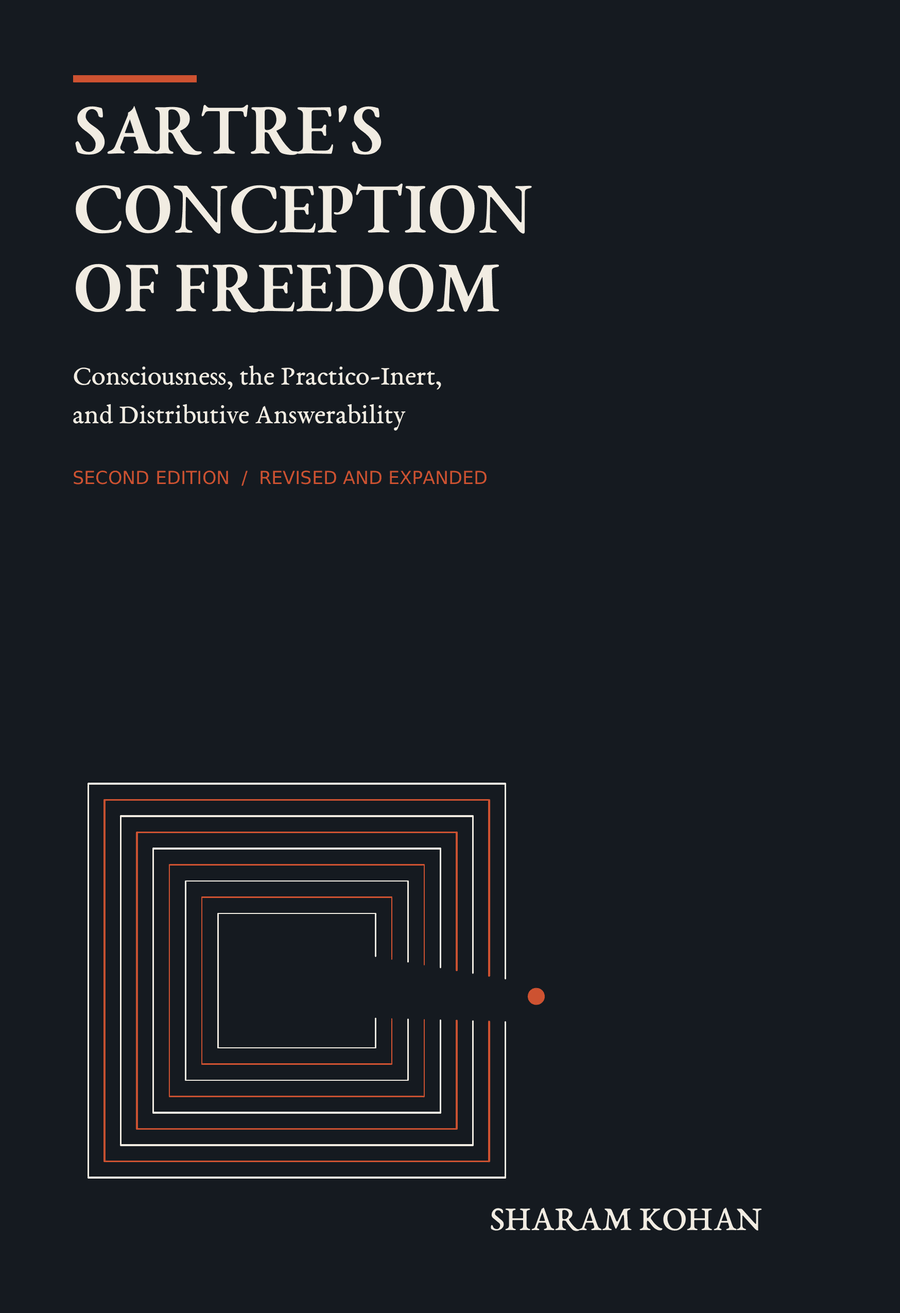
Sartre's Conception of Freedom
Consciousness, the Practico-Inert, and Distributive Answerability
Freedom is not worldly omnipotence. The decisive question is how a conscious agent takes up a situation whose possibilities, costs, and powers are unevenly distributed.
Sharam Kohan · Doxprint LLC · Hardcover
One claim, two registers
Ontological freedom and practical efficacy
Two questions have been asked under one word. Separating them is what allows the early ontology and the later social theory to be read as one argument rather than two.
| Question | First register: ontological freedom | Second register: practical efficacy |
|---|---|---|
| What it names | The formal non-coincidence of the for-itself with every factual description of it. | The situated power to form, sustain, and realize projects within a resistant world. |
| Whether it admits of degree | No. It is structural and universal, neither increased by privilege nor abolished by confinement. | Yes. It is enlarged by knowledge, health, resources, rights, and solidarity, and diminished by their absence. |
| How it is distributed | Equally. Every for-itself possesses it and none can surrender it. | Radically unequally, through bodies, institutions, and the sedimented activity of others. |
| Where the book develops it | Chapters One through Four, and Chapter Five, sections IX and X. | Chapter Five onward, and above all Chapters Seven and Eight. |
Bibliographic data
- Title
- Sartre's Conception of Freedom
- Subtitle
- Consciousness, the Practico-Inert, and Distributive Answerability
- Edition
- Second edition, revised and expanded
- Author
- Sharam Kohan
- Publisher
- Doxprint LLC
- ISBN
- 979-8-234-17877-0
- Format
- Hardcover, $39.99
- First edition
- 2012
- Second edition
- 2023
Consciousness / Situation / Answerability. From ontology to the social field of practical freedom.
Eleven chapters, from the two regions of being to the division of remedial responsibility
The volume opens with a preface to the second edition and a note on texts, translations, and citations, and closes with a conclusion and a table of references.
| Division | Title | Sections |
|---|---|---|
| Introduction | The Problem of a Freedom Said to Be Absolute | 6 |
| Chapter One | The Two Regions of Being | 7 |
| Chapter Two | Consciousness and the Expulsion of the Ego | 6 |
| Chapter Three | Nothingness and the Work of Negation | 7 |
| Chapter Four | Freedom as the Being of the For-Itself | 9 |
| Chapter Five | Facticity, Situation, and the Two Registers of Freedom | 10 |
| Chapter Six | Bad Faith and the Flight from Freedom | 8 |
| Chapter Seven | Anguish, Situated Answerability, and the Approach to an Ethics | 15 |
| Chapter Eight | The Social Turn: Conditioned Freedom and Distributive Answerability | 15 |
| Chapter Nine | Comparative Stress Tests in Responsibility Theory | 6 |
| Chapter Ten | Three Objections and the Limits of the Reply | 7 |
| Chapter Eleven | The Interpretation and Theory Under Pressure | 9 |
| Conclusion | Untitled in the volume | 4 |

Sharam Kohan
Sharam Kohan is the author of Sartre's Conception of Freedom. In this revised and expanded second edition, he extends the original study beyond Being and Nothingness to Sartre's later social philosophy and develops the book's account of situated and distributive answerability.
He is also the author of Judgment, a Priori Itself (1997) and The Honest Organization (2019).