
Sartre's Conception of Freedom
Consciousness, the Practico-Inert, and Distributive Answerability. Second edition, revised and expanded.
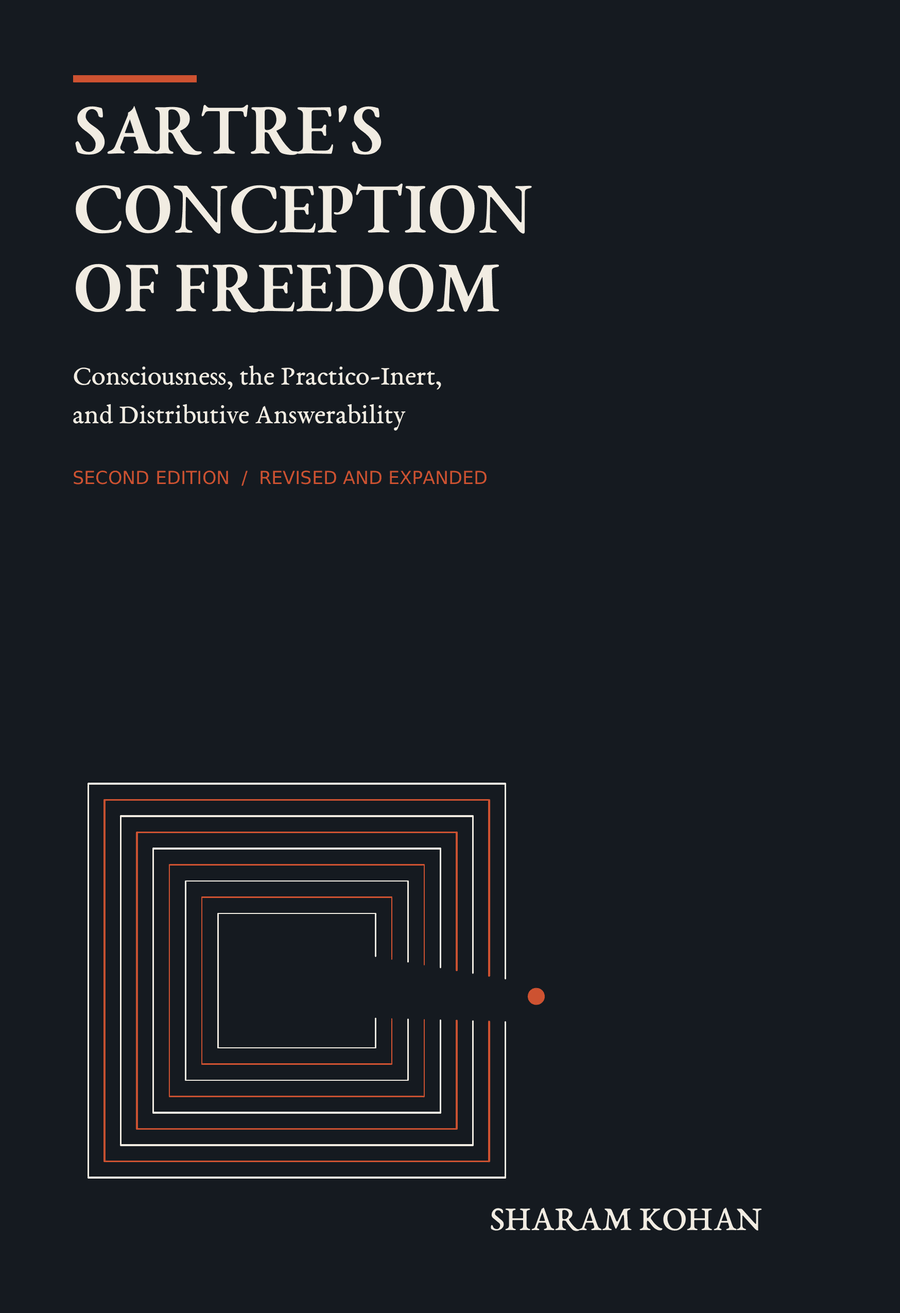
A revised account of Sartrean freedom
Few doctrines in twentieth-century philosophy are as famous, or as contested, as Sartre's claim that human beings are condemned to be free. This revised and expanded second edition follows that claim from the ontology of Being and Nothingness into the social and material world of the Critique of Dialectical Reason.
It argues that the apparent conflict between absolute freedom and conditioned praxis becomes clearer once two registers are distinguished: freedom as the non-coincidence of consciousness with any complete factual description, and practical efficacy as the situated power to make a project effective in the world. The book then develops a theory of situated and distributive answerability, asking how institutions allocate knowledge, authority, alternatives, costs, and remedial power, and how those distributions should shape judgments of responsibility.
What the second edition changes
The first edition, published in 2012, remained almost entirely within the horizon of Sartre's early philosophy. It ended with the solitary for-itself of Being and Nothingness, as though Sartre's analysis of freedom ended there as well. It did not.
The revision proceeds from three reasons. The first concerns scope: the Critique of Dialectical Reason brings the earlier ontology into contact with history, scarcity, worked matter, institutions, and the resistant presence of other people, and any account that omits it omits a substantial part of Sartre's position. The second is argumentative: the first edition made too little contact with the strongest objections, and Merleau-Ponty's charge that an absolute freedom is empty, together with the determinist's suspicion that a freedom unconditioned by the past explains nothing, cannot be dismissed in passing. The third supplies the organizing thesis, the distinction between the two registers.
The expanded material does not attach an unrelated moral theory to the interpretation. It tests whether the interpretation yields a defensible account of answerability in cases that do not depend upon Sartre's own examples: many hands, manipulation, culpable ignorance, structural injustice, and standing to blame.
What the book is not
It is not a biography, and it does not appeal to episodes in Sartre's life as explanations or excuses for his arguments. Nor is it a general introduction to existentialism, a label whose popular associations often obscure the specificity of Sartre's philosophy. The question is narrower: what conception of freedom emerges from Sartre's ontology and social theory, and how much of that conception remains defensible.
Freedom is not worldly omnipotence. The decisive question is how a conscious agent takes up a situation whose possibilities, costs, and powers are unevenly distributed.
Bibliographic data
- Title
- Sartre's Conception of Freedom
- Subtitle
- Consciousness, the Practico-Inert, and Distributive Answerability
- Edition
- Second edition, revised and expanded
- Author
- Sharam Kohan
- Publisher
- Doxprint LLC
- ISBN
- 979-8-234-17877-0
- Binding
- Hardcover
- Price
- $39.99
- First edition
- 2012
- Second edition
- 2023
- Language
- English
- Printed
- United States of America
- Subject headings
- Philosophy / Movements / Existentialism; Philosophy / Movements / Phenomenology; Philosophy / Ethics and Moral Philosophy; Philosophy / Free Will and Determinism
Page count and the precise publication date of the second edition are not yet published here. They will be added once confirmed against the printer's record.
How to cite this book
Sharam Kohan, Sartre's Conception of Freedom: Consciousness, the Practico-Inert, and Distributive Answerability, 2nd ed., rev. and exp. (Doxprint LLC, 2023).
A note on citing the primary texts
The English editions of Hazel E. Barnes's translation of Being and Nothingness do not share a common pagination, and the pagination of the French text differs again. References to Being and Nothingness therefore identify internal divisions, including part, chapter, and, where useful, titled section. The work is abbreviated BN. References to the Critique of Dialectical Reason follow Alan Sheridan-Smith's translation; references to Notebooks for an Ethics follow David Pellauer's translation.
This site follows the same practice. It does not supply a page number for any edition that does not support one.
Obtaining a copy
The hardcover is $39.99. Retail links are being finalized and will appear here; in the meantime, orders and trade inquiries may be sent to the publisher directly.
Booksellers and libraries may order by ISBN 979-8-234-17877-0.
Before ordering, a reader can judge the book from the site itself. The Preface and the Introduction are published in full in the excerpt. The distinction the argument turns on is set out on Two Registers. Every chapter and numbered section is listed in the contents. And the works the book actually cites, rather than a list of what it might have cited, are given in the Table of References.